


Estimated reading time: 13 minutes
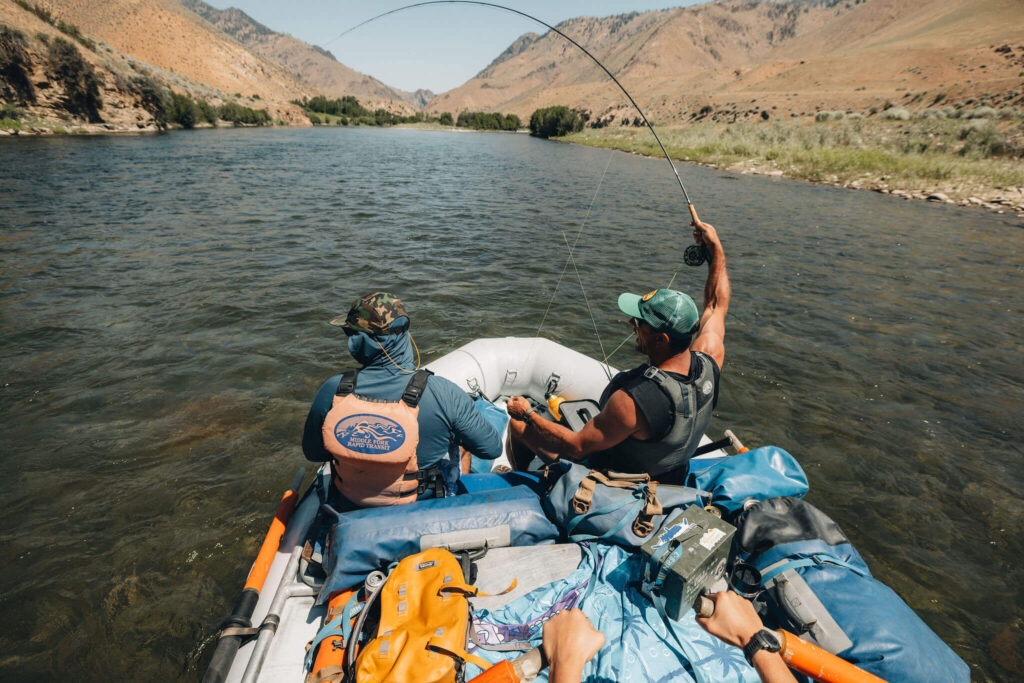
Middle Fork fly fishing rewards observation more than distance. From a moving raft, a short cast into the right current seam usually matters more than a long cast that lands beyond it. From shore, the same principle holds: read where fast water meets slow water, make the cleanest presentation you can, and change one variable at a time.
This is an on-water playbook for those decisions. It covers holding water, raft-based drifts, practical fly styles, common presentation problems, and fish-care ethics. For the complete season, tackle, clothing, and trip-planning overview, start with our Middle Fork fly-fishing guide.
Middle Fork Tactics at a Glance
| What you see | A useful first move |
|---|---|
| Soft water along a bank or inside bend | Land a buoyant dry just upstream of the cushion and keep the drift short enough to control |
| A seam between fast and slow current | Place the fly near the current boundary and manage slack so it travels with one speed of water |
| A boulder pillow, shoulder, or downstream pocket | Cast above the feature and let the fly enter naturally instead of landing directly on the fish’s likely position |
| A riffle spilling into a run or tailout | Cover the broken water first, then lengthen the drift as the current smooths and deepens |
| No surface interest in otherwise good water | Improve depth or add a barbless dropper when appropriate before replacing the entire fly box |
| Clear, flat water with follows or refusals | Reduce splash and drag; then try a smaller or less conspicuous profile |
These are starting points, not formulas. Flow, clarity, wind, light, insect activity, boat speed, and fish response can change within an hour. Your guide has the best view of the current lane and the safest casting window.
Confirm the Rules Before Choosing a Rig
Technique begins with a legal setup. Idaho Fish and Game’s current Middle Fork Salmon River listing identifies three core special rules for the Middle Fork and listed tributaries:
- Trout are catch-and-release only.
- Bait is not allowed.
- Barbless hooks are required.
Other species, tributaries, regional boundaries, and salmon or steelhead seasons can introduce additional rules. Use our dedicated Middle Fork fishing-regulations guide for the full planning explanation, then verify the current IDFG source before fishing. Bring the appropriate Idaho license.
This article discusses dry flies, droppers, nymphs, and streamers as presentation categories. It does not determine whether a particular multi-fly rig, weight, lure, target species, or location is legal on the day you fish. Confirm the current rule and follow your guide’s direction.
Read the Water Before Changing the Fly
The Middle Fork offers miles of attractive water, but trout do not distribute themselves evenly. They need food delivered by current and a place where holding does not cost more energy than feeding provides.
Bank cushions and inside bends
Along an outside bank, friction slows a thin layer of water against shore. On an inside bend, the main current often shifts away and leaves a broader soft lane. During stronger flows, those margins can be especially useful.
Do not cast at the bank as an abstract target. Look for a small change in texture: a foam line, a darker slot, a submerged shelf, or the quiet water beside faster current. Land above that feature so the fly is already behaving naturally when it reaches the holding water.
Seams
A seam is where neighboring currents move at different speeds. Food can collect along the boundary while a fish holds on the slower side. The challenge is that fly line touching the faster lane can pull the fly unnaturally.
Make the cast with a specific lane in mind. Use an early mend or reposition the rod tip before the line becomes tight. If the fly begins to skate, the drift is over; pick it up cleanly rather than dragging it through the rest of the run.
Boulders, ledges, and pockets
A boulder divides the current into several targets: the soft pillow upstream, the shoulder along either side, and the pocket or eddy behind it. A submerged ledge can create the same kind of pressure change without an obvious rock above water.
Start upstream of the structure. A fly dropped directly into the calm center may splash on top of the fish or miss the feeding lane around the edge. When the raft is moving quickly, choose one part of the feature and make a controlled presentation rather than trying to cover all of it with a long cast.
Riffles, runs, and tailouts
Broken riffle water gives trout overhead cover and delivers food. As a riffle deepens into a run, look for subtle troughs and converging bubbles. At the tailout, current slows and the surface becomes easier to disturb.
Fish the textured water with a visible, buoyant pattern. As the drift reaches smoother water, reduce line movement and be ready for a quieter rise. If you walk a run from shore, work from the near water outward so you do not cast over fish or wade through the first useful lane.
Fly Fishing From a Moving Raft
Raft fishing changes the geometry. The boat, fly, and current are all moving, often at different speeds. The goal is not to create a long textbook drift; it is to make a series of accurate, useful presentations while the guide controls the boat.
Build a repeatable cast
- Choose one target before lifting the line. A bank cushion, seam, or boulder shoulder is more useful than “somewhere ahead.”
- Check the casting lane. Know where the guide, other guests, spare rods, and equipment are before the forward cast.
- Use only the line you can control. Short casts reduce tangles and let you place the fly ahead of the target.
- Land upstream of the holding water. Give the fly time to settle before it enters the feeding lane.
- Manage slack immediately. Mend, follow the fly with the rod tip, or retrieve excess line before the boat overtakes it.
- End the drift deliberately. Pick up before the line wraps an oar, catches shoreline vegetation, or trails behind the boat.
Repeated false casting consumes the short window and puts hooks near other people. Let the fly fish. When the guide asks everyone to stop casting for a rapid, landing, or boat maneuver, secure the hook and line promptly.
Coordinate the hook set and landing
With a dry fly, a rushed strike can pull the pattern away; a long pause can let a fish reject it. Lift firmly after the take is clear rather than making a powerful overhead hook set. Keep the rod bent and communicate the direction of the fish so the guide can protect the line from oars, the boat, and nearby structure.
Do not tighten the drag or clamp the line simply because the fish runs. Smooth pressure and appropriate tippet land fish more efficiently than sudden force. The guide may move the raft to safer water before netting or releasing the fish.
A Presentation Ladder: Change One Thing at a Time
When a run looks productive but does not produce, random fly changes hide the real problem. Work through a short diagnostic ladder.
1. Fix the drift
Watch the fly against nearby bubbles. If it travels faster, slower, or sideways, line drag is likely. Shorten the cast, change the angle, mend earlier, or hold less line on the water. A familiar fly with a clean drift is usually a better test than a new fly dragging through the same lane.
2. Change the position
Move the presentation a foot closer to the bank, along the other side of the seam, or through a different shoulder of the boulder. Adjust the landing point, not merely the distance. When fishing from a raft, one precise cast to each new pocket is often the efficient rhythm.
3. Change the depth
If fish are not looking up, a guide may suggest a dry-dropper or another legal nymph presentation. Match the dropper length and weight to the actual slot; a rig hanging below the fish is no more useful than one drifting above them. Keep the setup simple enough to cast safely from the boat and make sure every hook is barbless.
4. Change the profile
A bulky, visible dry can be excellent in broken water. In clear, smooth water, a smaller caddis, mayfly, ant, or beetle profile may land more softly. If fish follow a streamer without committing, change retrieve speed or angle before cycling through colors.
5. Ask what the fish just told you
A refusal is information. A fish that rises and turns away probably saw the fly, so presentation or profile may be the issue. No response can mean the fly missed the lane, rode at the wrong depth, or passed through unoccupied water. A missed take may be timing rather than pattern. Make the next change answer one of those possibilities.
Build a Fly Box by Function
You do not need a box that predicts every hatch. You need a few dependable profiles that cover different jobs. Our complete Middle Fork fly-fishing guide owns the broader tackle checklist; this is the compact working selection.
| Job | Useful starting patterns |
|---|---|
| Stay visible and float through broken water | Chubby Chernobyl, Fat Albert, or Stimulator-style attractors, commonly in sizes 8–14 |
| Match smaller surface insects or soften the landing | Elk Hair Caddis, Parachute Adams, Purple Haze, or similar caddis/mayfly profiles, commonly in sizes 12–18 |
| Suggest a terrestrial near banks and vegetation | Hopper patterns in roughly sizes 8–12; ants and beetles in roughly sizes 12–16 |
| Reach fish below a dry | Barbless stonefly nymphs, Pheasant Tails, Hare’s Ears, or Prince Nymphs across a practical size range |
| Explore deeper pockets with movement | Small natural-color Woolly Bugger or sculpin-style streamers when your guide confirms the rig, target, and casting situation are appropriate |
Treat sizes and names as starting ranges, not a shopping quota. A pattern that floats reliably, can be seen, and can be removed quickly may be more useful than an exact imitation that is difficult to manage from a boat.
Before the trip, pinch barbs and inspect each hook point. Carry a small working selection where it can be reached without opening a large box over the river. Replace damaged leaders and discard clipped tippet in a secure container, never into the boat floor or water.
Troubleshoot Common Problems
The fly skates across the current
Your line is probably crossing water that moves at a different speed. Shorten the cast, land with less line on the surface, change the casting angle, or mend sooner.
The fly sinks too quickly
Dry it, apply the appropriate treatment, simplify an overly heavy dropper, or change to a more buoyant profile. Repeated aggressive false casting can dry a fly, but it also wastes the target window and creates a hook hazard in the raft.
Fish rise but refuse
First improve drag and landing. Then try a smaller, quieter, or less bulky pattern. In flat water, leader placement and splash may matter more than color.
The rig tangles repeatedly
Use fewer false casts, open the loop, slow the casting stroke, and ask whether the dropper is longer or heavier than the situation requires. A simple dry-fly rig that stays fishing beats an elaborate rig that stays knotted.
Wind ruins the cast
Shorten the target, keep the loop controlled, and let the guide position the boat. Do not force a cast across another guest. A missed pocket is better than a hook injury.
Fish-Care Ethics: Plan the Release Before the Cast
Catch-and-release works best when the release is built into the tackle and landing plan. Idaho Fish and Game’s catch-and-release basics advise landing a fish quickly, leaving it in the water, using wet hands, and cutting the line close when a hook is swallowed rather than digging for it.
Use this sequence:
- Choose adequate tackle. Use tippet strong enough to land the expected fish without an unnecessarily long fight.
- Prepare the tools. Keep forceps or pliers and, if used, a soft rubber net within reach before fishing.
- Keep the fish over or in water. Do not place it on rocks, sand, a dry boat floor, or clothing.
- Wet your hands. Support the fish gently without squeezing its body or covering its mouth and gills.
- Remove the hook efficiently. A barbless hook often releases with minimal handling. If deeply swallowed, follow IDFG guidance and cut the line close.
- Make photography secondary. Have the camera ready first. Photograph in the water when possible; if the fish is lifted, keep it low, brief, and over water.
- Release without unnecessary handling. The science-based Keep Fish Wet principles emphasize minimizing air exposure, eliminating contact with dry surfaces, and reducing handling time.
Most fish that remain upright and can swim should be released without prolonged “revival.” If a fish has lost equilibrium, Keep Fish Wet’s release tips recommend keeping it submerged with its head facing into moving water until it can maintain balance. Do not move a fish backward through the water.
Water temperature, fight time, fish condition, and species all affect stress. Avoid treating one temperature number as a universal permission slip. On a hot afternoon or when fish recover poorly, shorten fights, stop photographing, change location or timing, and follow the guide’s decision to pause fishing.
For identification details and species-specific handling concerns, use our Middle Fork fish guide.
Ethics Beyond the Fish in Your Hand
Responsible fishing also protects the river and other people using it.
- Give other anglers room. Do not have the raft pull directly into water another group is actively fishing. From shore, ask before entering a run and avoid casting over someone else’s line.
- Protect spawning gravel. Redds are cleared nests in gravel, often visible as a lighter patch. Idaho Fish and Game advises people to avoid stepping on them and to cross away from the nest. Follow your guide where visibility is poor.
- Secure every scrap. Clipped tippet, leaders, strike indicators, and packaging are easy to lose and can entangle wildlife. Use a dedicated waste container.
- Keep wildlife wild. Do not cast toward, crowd, or pursue animals at the water’s edge.
- Respect the boat plan. Fishing stops when the guide needs attention for rapids, landings, equipment, or group movement.
- Share useful information without claiming water. A good run is part of a public river, not a possession.
The result is a better trip as well as better stewardship: fewer tangles, safer boat movement, less handling, and more time with a fly making a useful drift.
Middle Fork Fly Fishing Tactics FAQ
There is no single best pattern. Start with a visible, buoyant attractor in broken water, then let current speed, depth, insect activity, and fish response determine the next change. Improve the drift and target lane before replacing the fly.
Yes. A beginner can be effective with a short cast, one target at a time, and simple line control. Tell the guide your experience level so the boat position, rig, and coaching match your ability.
Start with the simplest presentation that reaches feeding fish. A dry fly is easier to cast and release from; a guide may add a barbless dropper when fish are feeding below the surface and the current rules and boat situation allow it.
MFRT’s current trip information tells guests to bring personal fishing gear and an Idaho license, while River 101 links to Stanley rental options. Use the [complete fly-fishing gear guide](https://middleforkrapidtransit.com/middle-fork-salmon-fly-fishing-guide/) and confirm current arrangements with MFRT before departure.
No. Idaho Fish and Game’s current special rule lists trout as catch-and-release only on the Middle Fork and named tributaries. No bait is allowed and barbless hooks are required. Verify the latest rule before fishing.
Keep the fish submerged, minimize handling and photography, and follow your guide. If fish are recovering poorly, the responsible adjustment may be stronger tackle, a different location or time, or stopping fishing rather than continuing to catch stressed trout.
Put the Tactics Into Practice
Good Middle Fork fishing is a sequence of small decisions: choose a lane, make a controlled drift, learn from the response, and plan the release before the fish is hooked. The river supplies the variation; practiced line control and thoughtful handling supply the consistency.
MFRT offers fishing opportunities on regular departures and a dedicated September Fishing Adventure. Contact Middle Fork Rapid Transit to discuss the current trip format, your experience level, and how much fishing you want in the itinerary.