

Estimated reading time: 5 minutes
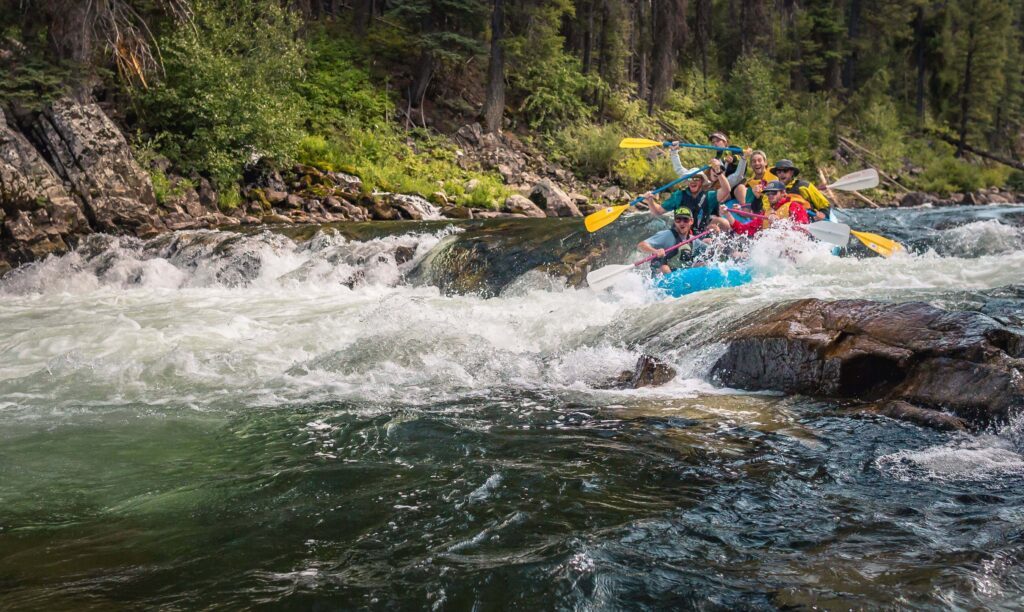
June on the Middle Fork is colder, faster, and more continuous than a typical midsummer trip. It can be an excellent choice for athletic guests who actively want big-water energy. It is not the default recommendation for every first-timer or family.
This guide helps you decide whether the experience fits. It does not establish a universal “safe” river level or replace MFRT’s trip-specific operating decision.
What High Water Means
The Middle Fork is a free-flowing, snowmelt-driven river. Spring warming releases mountain snow, and tributaries combine to create the early-season rise. The exact peak and daily flow vary by snowpack and weather.
A gauge number is useful only with the correct station, date, trend, and operational context. Read the Middle Fork CFS guide for gauge interpretation. Do not convert a permit rule or one historical level into a universal commercial-launch cutoff.
How June Feels Different
Faster current
The current carries boats downstream more quickly, so rapid sequences and transitions can feel more continuous. Guide commands may come with less time for discussion in the moment.
Larger wave trains
Features that feel technical or rocky later in the season may become larger, faster wave trains. The exact rapid character changes with the water level; high water does not simply make every named rapid one class harder.
Colder water
Snowmelt is cold. Splash and an unexpected swim have greater consequences than the same air temperature might suggest. Warm sun does not remove the need for cold-water preparation.
More flexible stops
Current, landing conditions, timing, and assigned camps determine which hot spring, hike, or cultural stop is practical. June is primarily a whitewater choice, not a guarantee of every side activity.
Who Is a Strong Fit?
June high water often fits guests who:
- want an athletic, fast-moving river experience;
- are comfortable following immediate guide commands;
- can manage cold, wet conditions without losing focus;
- accept that boat choices and side stops are operational decisions;
- have realistic expectations about wilderness risk;
- are age 14 or older under MFRT’s general June 2–20 guidance.
Experience helps, but mindset matters too. A fit guest can be new to rafting and still listen well, communicate early, and accept the guide team’s plan.
Who Should Consider a Later Date?
A later date may be better for:
- younger children;
- guests highly sensitive to cold;
- someone whose main goal is relaxed fishing or frequent side stops;
- families that need the widest boat-choice flexibility;
- anyone who dislikes continuous motion or fast commands;
- a guest whose medical or mobility needs are harder to manage in cold, rapid conditions.
Use the high-water versus late-season comparison for that two-window decision, or the best-time guide for the full season.
Age and Family Guidance
MFRT’s current FAQ gives a general minimum age of 14 for June 2–20 high-water trips. Limited exceptions for experienced younger river travelers require an individual conversation and are not a blanket promise.
Age alone is not enough. The family overview explains seasonal ages and boat options, while the child-readiness checklist helps evaluate a particular child.
Safety and Operational Decisions
The guide team evaluates current conditions, guest needs, boats, route, weather, and access as a connected system. MFRT may adjust the put-in, boat plan, schedule, clothing guidance, or other logistics when conditions call for it.
Boundary Creek and Indian Creek are operational alternatives, not guest-selected products. See the put-in guide for their condition-based roles.
The Middle Fork safety standards article owns the full explanation of guide qualifications, required equipment, communications, emergency planning, and guest responsibilities.
Recreation.gov’s late-cancellation provision for certain readings above five feet is a permit-administration rule. It is not a universal statement that five feet is the point at which an MFRT trip is safe or unsafe.
What to Pack
Follow the current departure instructions first. A June system normally emphasizes:
- waterproof rain jacket and pants;
- warm synthetic or wool base layers;
- fleece or compact insulation;
- warm hat and dry camp socks;
- secure river footwear;
- sunscreen and sunglasses;
- any wetsuit, drywear, or other cold-water item MFRT specifies for that trip.
Do not assume MFRT provides a helmet or that every guest spends the full day in a wetsuit. Confirm the actual equipment plan. The master packing list keeps the complete list in one place.
Questions to Ask Before Booking
- Does everyone in the group actively want the high-water experience?
- How does each person react to cold, uncertainty, and fast instructions?
- Are ages and health considerations aligned with the departure?
- Would the group still be happy if a preferred boat or side stop were unavailable?
- Has MFRT received the group’s relevant medical, mobility, and experience information?
A candid conversation is more useful than choosing June solely because it sounds adventurous.
June High-Water FAQ
No public number should be treated as a universal MFRT cutoff. The operating decision considers the station, trend, access, weather, boats, guests, and current river conditions.
No. The cited provision concerns a late-cancellation exception for a private permit. It does not define a universal commercial operating threshold.
Equipment can vary by departure. Follow the trip-specific information and ask MFRT directly; do not rely on a broad legacy promise.
MFRT’s general minimum for June 2–20 is age 14, with limited individual exceptions for experienced younger guests. Readiness and current conditions still matter.
No. Current, landings, camp assignments, timing, and weather determine optional stops.